

The 403 declaration (403-verklaring) is the written declaration with which a consolidating parent company accepts joint and several liability for the debts arising from legal acts of a group company. It is the core of the group exemption (groepsvrijstelling) of Article 2:403 of the Dutch Civil Code (BW): the subsidiary does not have to prepare its own annual accounts in accordance with Title 9, have them audited, or publish them. With the Dutch Chamber of Commerce (KVK) you file the 403 declaration (once), a statement of consent for each financial year, and, annually, the parent's consolidated annual accounts.
Key facts
For whom: a legal entity belonging to a group (group company, art. 2:24b BW) whose financial data is included in consolidated annual accounts governed by EU accounting law.
Legal basis: art. 2:403 BW; withdrawal and the residual liability are governed by art. 2:404 BW.
What you file with the KVK: the 403 declaration (once), the statement of consent (per financial year), and, annually, the consolidated annual accounts with the auditor's report and the management report.
Deadline for the consolidated documents: each time within 6 months after the balance sheet date, or within 1 month after a lawful later publication.
Language: Dutch, French, German, or English; the auditor's report and the management report in the same language as the consolidated annual accounts.
Digital filing: for financial years starting on or after 1 January 2025, electronic filing via SBR is mandatory, with a choice between XBRL and iXBRL.
What is a 403 declaration?
A 403 declaration (formally: a declaration of liability, aansprakelijkheidsverklaring) is the declaration with which the consolidating legal entity or company, usually the parent, accepts joint and several liability for the debts arising from legal acts of the group company (art. 2:403(1)(f) BW). Because of the exemption, the subsidiary's creditors lose sight of its published annual accounts; the parent's assumption of liability takes their place. Creditors can therefore also recover their claims from the parent.
Note: the declaration only covers debts arising from legal acts, such as supplies, loans, and other contracts. Obligations that do not arise from a legal act fall outside the scope of the 403 declaration.
What the exemption does and does not cover
The group exemption is often summarised as “no own annual accounts needed anymore”. That is an oversimplification. What actually changes:
Simplified preparation. The entity's own annual accounts do not have to follow the presentation requirements of Title 9. Simplified annual accounts suffice: a balance sheet stating at least the total of fixed assets, the total of current assets, and the amounts of equity, provisions, and liabilities, and a profit and loss account stating the result from ordinary operations and the balance of other income and expenses, after tax (art. 2:403(1)(a) BW).
No audit, no management report, no publication. Articles 2:391 through 2:394 BW do not apply (art. 2:403(3) BW). The subsidiary therefore does not have to prepare a management report, undergo a statutory audit, or file its own annual accounts with the KVK.
The own annual accounts do not disappear. The simplified annual accounts must still be prepared and adopted; after all, the statement of consent must be issued before that adoption.
The bookkeeping obligation remains. The obligation of art. 2:10 BW to keep and retain records remains fully in force.
All conditions for the group exemption
The exemption of art. 2:403(1) BW applies only as long as all of the following conditions are met:
Simplified own annual accounts. The subsidiary's balance sheet and profit and loss account state at least the statutory minimum line items (sub a).
Written consent per financial year. The members or shareholders declare in writing that they consent to the deviation, after the start of the financial year and before the adoption of the annual accounts for that year (sub b).
Consolidation under EU accounting law. The subsidiary's financial data is consolidated in consolidated annual accounts governed by the IAS Regulation, Directive 2013/34/EU, or one of the EU directives for banks and insurers (sub c). In practice this means consolidation by a parent in the Netherlands or in another EU/EEA member state.
Language. The consolidated annual accounts are drawn up or translated in Dutch, French, German, or English (sub d), and the auditor's report and the management report are in the same language (sub e).
Joint and several liability. The consolidating legal entity or company has declared in writing that it accepts joint and several liability for the debts arising from legal acts of the subsidiary (sub f).
Filing. The statement of consent and the 403 declaration have been filed with the trade register, and the consolidated annual accounts with the auditor's report and the management report are filed each time within 6 months after the balance sheet date, or within 1 month after a lawful later publication (sub g).
If one of these elements is missing, the exemption does not (or no longer) apply and the group company is subject to the standard preparation, audit, and publication requirements for its own annual accounts. Special case: if the consolidating company and another company within the group are of equal rank (coordinate entities), that other legal entity or company must also issue a declaration of liability (art. 2:403(2) BW).
Exactly what you file with the KVK
The group exemption does not lead to “filing nothing”, but to a different set of documents. The filing mechanics differ per document:
Document | Frequency | Deadline and channel |
|---|---|---|
403 declaration | Once; remains in force until withdrawal | By post, as an original with original signatures |
Statement of consent | Per financial year | After the start of the financial year and before adoption of the annual accounts for that year; by post or e-mail |
Consolidated annual accounts (with auditor's report and management report) | Annually | Within 6 months after the balance sheet date, or within 1 month after a lawful later publication |
In practice: you file the 403 declaration by post with KVK Backoffice Verklaringen; a later withdrawal must also be an original with original signatures. The statement of consent can be submitted by post or by e-mail. KVK accepts these declarations in Dutch, English, French, or German.
Example: the subsidiary's financial year equals calendar year 2025. The shareholders sign the statement of consent between 1 January 2025 and the adoption of the 2025 annual accounts. The 403 declaration is already on file from an earlier year and does not need to be filed again. The parent's 2025 consolidated annual accounts must be on file at the trade register, with the auditor's report and the management report, by 30 June 2026 at the latest, or within 1 month after a lawful later publication.
Withdrawal: the 403 declaration does not end by itself
The 403 declaration remains in force until it is withdrawn. Withdrawal is effected by filing a declaration to that effect with the trade register (art. 2:404(1) BW). The withdrawal only works for the future: for debts arising from legal acts performed before the withdrawal can be invoked against the creditor, the parent remains liable (paragraph 2). This is called the residual liability (overblijvende aansprakelijkheid).
That residual liability towards a creditor only ends once four conditions are met (art. 2:404(3) BW):
the subsidiary no longer belongs to the group;
a notice of the intention to terminate has been available for inspection at the trade register for at least two months;
at least two months have passed since the announcement in a nationally distributed daily newspaper stating that and where the notice is available for inspection;
the creditor has not filed a timely objection, or the objection has been withdrawn or irrevocably declared unfounded.
Note: this is a classic point of attention when selling a subsidiary. Whoever only files the withdrawal declaration and forgets the termination procedure remains liable for all old debts arising from legal acts. A creditor may moreover demand security for claims for which liability is still running (art. 2:404(4) BW).
The 403 exemption versus the 408 exemption
The group exemption of art. 2:403 BW is often confused with the consolidation exemption for intermediate holding companies of art. 2:408 BW. They do different things:
Feature | Art. 2:403 BW (group exemption) | Art. 2:408 BW (intermediate holding exemption) |
|---|---|---|
Who uses it | A group company included in the parent's consolidation | An intermediate holding company that would itself have to consolidate |
What is waived | Title 9 presentation, statutory audit, and publication of the own annual accounts | Only the obligation to prepare its own consolidated annual accounts |
Own company-only annual accounts | Simplified, not published | Fully required, including the ordinary audit and publication requirements |
Declaration of liability | Yes: joint and several, for debts arising from legal acts | No |
What is on file at the trade register | 403 declaration, statement of consent, and the consolidated annual accounts | The consolidated annual accounts of the larger whole, within the same deadlines |
Digital filing from financial year 2025: SBR or iXBRL
For financial years starting on or after 1 January 2025, all legal entities are required to file their annual accounts electronically via SBR with the trade register; the Decree on electronic filing with the trade register (Besluit elektronische deponering handelsregister) was amended on 18 December 2024 to this end. Micro and small legal entities have been filing digitally since financial year 2016 and medium-sized ones since financial year 2017; what is new is the obligation for the large size class. Financial year 2024 served as a voluntary transition period. There is a choice of format: the familiar XBRL format (a standardised XBRL instance document) or the European iXBRL format (XHTML with inline XBRL tags). What that difference means in practice is covered in our explainer on the difference between iXBRL and XBRL.
The accounting standards and the size class steer the choice. The XBRL format supports NL-GAAP only; groups reporting under IFRS use the iXBRL format. If the legal entity falls within the scope of the CSRD, the European format is always mandatory, because the sustainability report, as part of the management report, must be prepared in that format. Medium-sized and large legal entities also file an auditor's report, digitally signed under the SBR Assurance framework. When such a report is required is covered in our article on the auditor's report on the annual accounts; which size class you fall into is determined by the size criteria for the annual accounts.
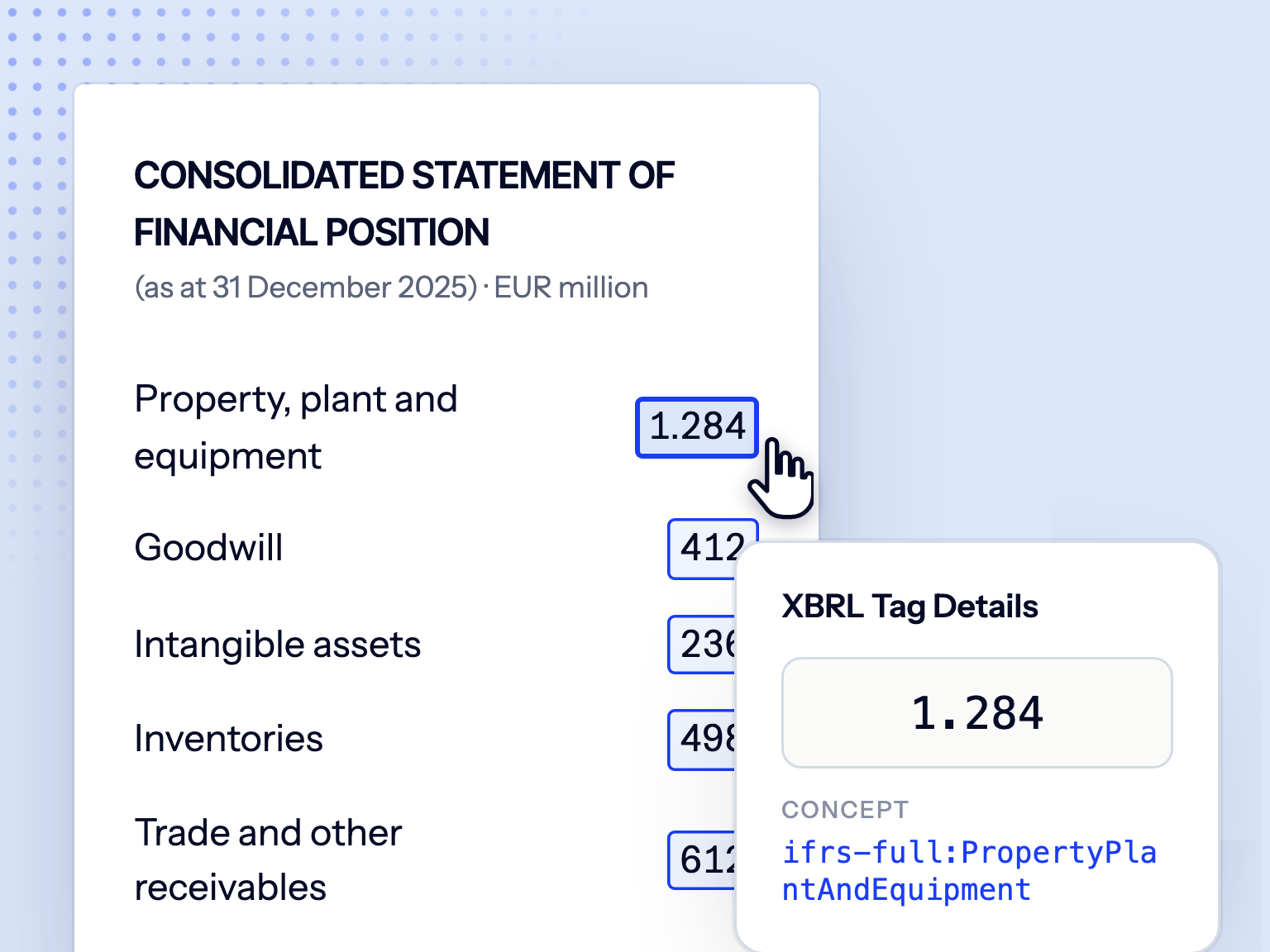
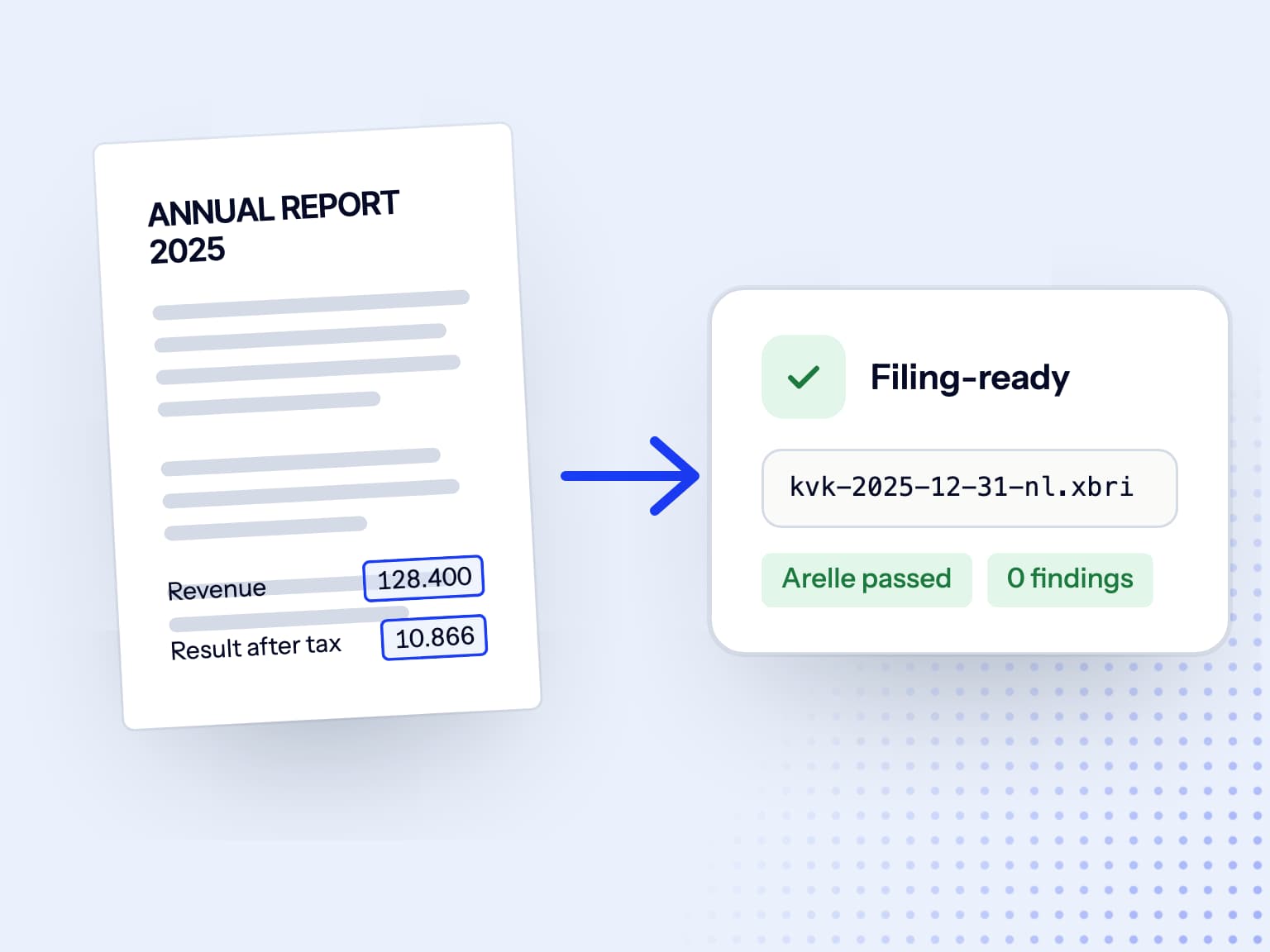
A specific regime applies to 403 filings with a foreign group head. The group annual report that the Dutch subsidiary files under the exemption must be submitted in the iXBRL format, but its content does not need to carry XBRL tags: only the mandatory filing data is tagged, in a separate iXBRL file within the report package. The taxonomy element kvk:AnnualReportOfForeignGroupHeadForExemptionUnderArticle403 must be reported with the value “True”; detailed tagging of the primary financial statements is not required. SBR Nederland publishes an example package (.xbri) for this. If the group has a Dutch parent, its consolidated annual report simply follows the ordinary filing rules of its own size class.
Do you want to see how existing consolidated annual accounts are converted into a valid iXBRL file? Read how converting annual accounts to XBRL works in practice.
Frequently asked questions
What is a 403 declaration? A 403 declaration is the written declaration with which a consolidating parent company accepts joint and several liability for the debts arising from legal acts of a group company. It is the core of the group exemption of art. 2:403 BW: by filing this declaration of liability, the subsidiary — provided the other conditions are also met — may suffice with simplified own annual accounts, without a statutory audit and without publication.
What is the difference between the 403 declaration and the statement of consent? The 403 declaration is the parent's assumption of liability; it is filed once and remains in force until withdrawal. The statement of consent is the written consent of the members or shareholders to the deviation and must be given per financial year: after the start of the financial year and before the adoption of the annual accounts for that year. It is therefore filed anew every year.
Does the subsidiary still have to prepare its own annual accounts? Yes. The exemption concerns the presentation, audit, and publication, not the existence of the annual accounts. The subsidiary prepares simplified annual accounts with the statutory minimum line items and adopts them; the bookkeeping obligation of art. 2:10 BW also remains fully in force.
Within what period must the consolidated annual accounts be filed? Each time within 6 months after the balance sheet date, or within 1 month after a lawful later publication. The consolidated annual accounts are filed together with the auditor's report and the management report, in the same language.
Can a foreign parent perform the consolidation? Yes, provided the consolidated annual accounts are governed by EU accounting law: the IAS Regulation, Directive 2013/34/EU, or one of the EU directives for banks and insurers (art. 2:403(1)(c) BW). In practice this means a parent in the Netherlands or in another EU/EEA member state. From financial year 2025, the Dutch subsidiary files the group annual report of a foreign group head in the iXBRL format, with only the filing data tagged.
How do I end the liability under a 403 declaration? In two steps. First you withdraw the declaration by filing a withdrawal declaration with the trade register; this ends the liability for new legal acts. The liability for existing debts (the residual liability) only ends after the procedure of art. 2:404(3) BW: the subsidiary is no longer a group company, the intention has been available for inspection at the trade register for two months, the announcement has appeared in a national daily newspaper, and there is no (successful) creditor objection.
In which format do I file the consolidated annual accounts: XBRL or iXBRL? For financial years starting on or after 1 January 2025, electronic filing via SBR is mandatory and you choose between the XBRL format and the iXBRL format. If the group reports under IFRS, you use the iXBRL format; if the legal entity falls under the CSRD, the European format is always mandatory. With a foreign group head, the iXBRL format is prescribed, with only the filing data tagged.
Doc2iXBRL for 403 filings
A 403 filing requires the right SBR entry point, correct tagging of the filing data and the consolidated annual accounts, and upfront validation of all documents together. Doc2iXBRL maps out the documents, validates against the filing rule set (Arelle plus our own pre-filing checks), and keeps the reviewer in control, without guaranteeing a KVK outcome. Do you want to see how this works for your group structure?
Request a demoSources
Dutch Civil Code Book 2, art. 2:403 and 2:404 (Title 9), wetten.overheid.nl: https://wetten.overheid.nl/BWBR0003045
Chamber of Commerce (KVK), Filing declarations: https://www.kvk.nl/deponeren/verklaringen-deponeren/
Chamber of Commerce (KVK), Filing with SBR: https://www.kvk.nl/deponeren/deponeren-met-sbr/
SBR Nederland, Expansion of electronic filing with the trade register (RTS, Reporting Manual, FAQ, and example packages): https://www.sbr-nl.nl/sbr-domeinen/handelsregister/uitbreiding-elektronische-deponering-handelsregister
SBR Nederland, FAQ SBR domain Handelsregister, version 19 November 2025: https://www.sbr-nl.nl/sites/default/files/2025-11/20251119_FAQ_NL_SBR-domein_Handelsregister.pdf
SBR Nederland, SBR Assurance: https://www.sbr-nl.nl/over-sbr/wat-is-sbr/sbr-assurance