

An accountantsverklaring (formally: the audit opinion, controleverklaring) is mandatory for legal entities that qualify as medium-sized or large. Micro and small entities are exempt from the statutory audit (art. 2:395a and art. 2:396(7) of the Dutch Civil Code, BW). The audit requirement follows from art. 2:393 BW; your size regime determines whether you are subject to it. Audit-obligated legal entities file the audit opinion digitally together with the annual accounts, via the SBR Assurance solution.
Key facts
Mandatory for: legal entities that qualify as medium-sized (art. 2:397 BW) or large (art. 2:398 BW).
Exempt: micro (art. 2:395a BW) and small (art. 2:396 BW); art. 2:396(7) BW declares the audit requirement of art. 2:393(1) not applicable to them.
Legal basis: art. 2:393 BW (the obligation to engage an accountant).
Who may audit: a registeraccountant (RA), an Accountant-Administratieconsulent (AA) with an audit annotation in the accountants register, or a statutory auditor within the meaning of the Audit Firms Supervision Act (Wta); the engagement may also be given to an audit firm.
Who grants the engagement: the general meeting; if it does not do so or does not exist, the supervisory board, and otherwise the management board (art. 2:393(2) BW).
Filing: the audit opinion is filed digitally as part of the deposit via SBR Assurance, in the same format as the annual accounts.
Decisive: the size regime, determined on the basis of the size criteria.
What is an audit opinion (accountantsverklaring)?
An accountantsverklaring is the written opinion of an accountant on the annual accounts. In the context of the statutory audit this is the controleverklaring (audit opinion): a statement on the true and fair view of the annual accounts. With it, the auditor provides reasonable assurance that the annual accounts give a true and fair view, in accordance with the applied framework (Dutch GAAP or IFRS).
The audit opinion is different from a compilation report (samenstellingsverklaring) or a review report (beoordelingsverklaring). A compilation report only confirms that the annual accounts have been prepared on the basis of the information provided, without audit assurance. A review report provides a more limited level of assurance than an audit. Only the audit opinion satisfies the statutory audit requirement of art. 2:393 BW.
⚠ “Accountantsverklaring” is used as an umbrella term in practice. For the filing obligation it specifically concerns the audit opinion issued in a statutory audit. A compilation or review report does not fulfil the audit requirement.
When is an audit opinion mandatory?
The statutory audit requirement depends on the size regime. A legal entity falls into a regime if, on two consecutive balance sheet dates, it meets at least two of the three criteria (balance sheet total, net turnover, average number of employees). A single deviating year therefore does not yet change the regime: only after two consecutive balance sheet dates on the other side of the threshold does the entity switch class.
Size regime | Statutory audit requirement | Audit opinion in the filing |
|---|---|---|
Micro (art. 2:395a BW) | No | Not required |
Small (art. 2:396 BW) | No | Not required |
Medium-sized (art. 2:397 BW) | Yes | Required, digitally via SBR Assurance |
Large (art. 2:398 BW) | Yes | Required, digitally via SBR Assurance |
⚠ Even without a statutory audit requirement, an audit opinion may be required contractually or under the articles of association, for example by a lender, a subsidy provider or the entity’s own articles. That is not a statutory filing obligation, but in practice it can still call for an opinion.
The size criteria in brief
For financial years starting on or after 1 January 2024, the threshold amounts for balance sheet total and net turnover were raised by approximately 25% (Implementation Decree raising the thresholds, Staatsblad 2024, 52). Legal entities were allowed, at their option, to apply the raised amounts to financial years starting on or after 1 January 2023 as well. The third criterion, the average number of employees, was not changed.
Size regime | Balance sheet total | Net turnover | Employees |
|---|---|---|---|
Micro | ≤ € 450,000 | ≤ € 900,000 | < 10 |
Small | ≤ € 7.5 million | ≤ € 15 million | < 50 |
Medium-sized | ≤ € 25 million | ≤ € 50 million | < 250 |
Large | > € 25 million | > € 50 million | ≥ 250 |
Worked example: a bv has, in two consecutive financial years, a balance sheet total of € 8.2 million, a net turnover of € 13 million and 60 employees. Only the turnover stays within the small-regime limit; the balance sheet total (above € 7.5 million) and the number of employees (50 or more) exceed it. The bv therefore does not meet two of the three small-regime criteria, qualifies as medium-sized and is subject to statutory audit: an audit opinion must be obtained for the annual accounts and filed along with them.
⚠ The raise also works the other way: a legal entity that was medium-sized under the old amounts may qualify as small under the raised thresholds, and after two consecutive balance sheet dates below the limits it then loses the statutory audit requirement. So re-test your class against the current amounts. All amounts, the counting rules and the transition questions are covered in the article on the size criteria for the annual accounts.
How the audit opinion is filed digitally
Since financial year 2025, all legal entities that must file their annual accounts with the Dutch Chamber of Commerce (KVK) file electronically via SBR (Decree on electronic filing with the trade register). Micro and small entities have done so since financial year 2016 and medium-sized entities since financial year 2017; for large legal entities the obligation applies from financial year 2025. There are two formats: XBRL (SBR Instance) or iXBRL (SBR Report Package). The audit opinion must be filed in the same format as the annual accounts.
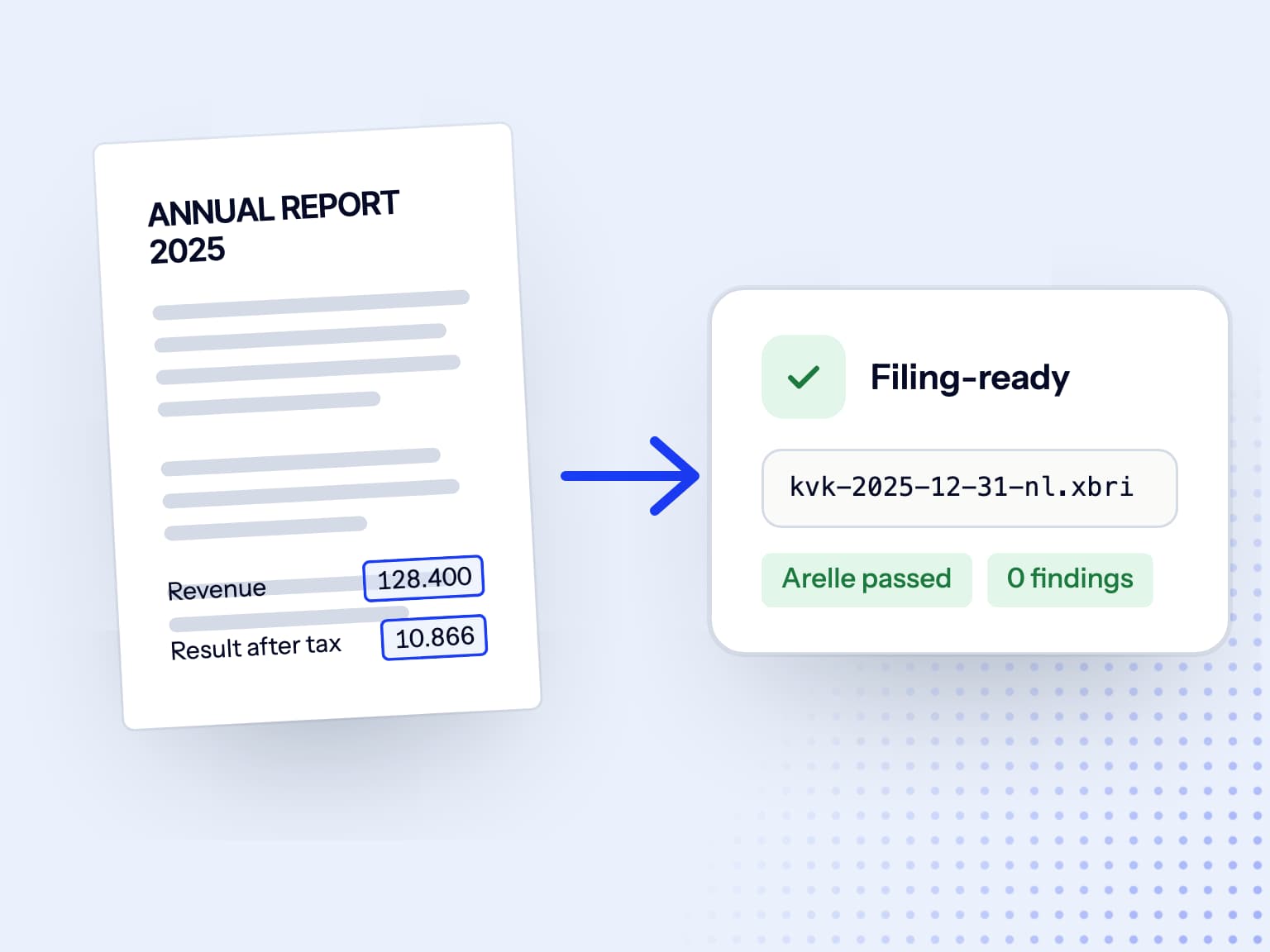
The SBR Assurance solution exists for filing the audit opinion digitally alongside the accounts. The auditor prepares the opinion as a separate digital document based on the NBA’s opinions taxonomy (verklaringentaxonomie) and signs it with a personal professional certificate; the wet-ink signature no longer exists in this process. Through “linking & signing” a detached signature is created: a separate file containing the electronic signature and check values (hashes) that inseparably binds the annual accounts and the opinion together. The KVK deposit therefore consists of three files: the annual accounts, the audit opinion and the detached signature.
Each size class moreover uses its own entry point in the KVK taxonomy; a large legal entity therefore files via a different entry point than a medium-sized one. See the article on electronic filing via SBR or iXBRL for the formats and the phase-in per regime, and what SBR is and how filing via SBR works for the background of the framework within which SBR Assurance operates.
The auditor’s consent for an SBR Report Package
In an iXBRL filing (SBR Report Package), the originally audited annual accounts are technically converted into XHTML with XBRL tags. That technical conversion falls outside the scope of the statutory audit. According to NBA Alert 50, including the audit opinion in the SBR Report Package counts as a new publication of the opinion: the auditor must give written consent for it, and first establishes that the human-readable XHTML version corresponds to the audited annual accounts, apart from any filing exemptions.
Anyone who also wants assurance on the XBRL tags themselves can additionally give the auditor a voluntary assurance engagement under Standard 3950N. Without such an engagement the tags are unaudited; NBA Alert 50 describes how the auditor makes this clear in an “other matters” paragraph in the audit opinion. So schedule the alignment with the auditor early in the filing process, especially in the first year of digital filing.
Audit opinion and the group exemption (art. 2:403 BW)
Under the group exemption of art. 2:403 BW the subsidiary is exempted from, among other things, the audit of its own annual accounts. Instead, it relies on the consolidated annual accounts of the parent, and those consolidated accounts must carry an audit opinion. The exemption moves the audit to the consolidated level; it does not make it disappear. From financial year 2025, the consolidated annual accounts and the accompanying audit opinion that are filed under art. 2:403(1)(d) and (e) BW must also be submitted electronically via SBR.
Types of opinion in the auditor’s report
The law (art. 2:393(6) BW) and the NBA auditing standards (Standards 700 and 705) distinguish four types of opinion. The type of opinion does not change the filing obligation: the report is filed along in all cases. The opinion reflects the outcome of the audit:
Unqualified opinion: the annual accounts give a true and fair view in all material respects.
Qualified opinion: there is a material misstatement, or the auditor could not obtain sufficient audit evidence, but the (possible) effects are not pervasive to the annual accounts as a whole.
Adverse opinion: the misstatements are both material and pervasive; the annual accounts do not give a true and fair view.
Disclaimer of opinion: the auditor is unable to obtain sufficient audit evidence and the possible effects could be both material and pervasive; no opinion is expressed.
Good to know: without the required audit opinion the annual accounts in principle cannot be adopted (art. 2:393(7) BW), unless a lawful reason for its absence is stated in the other information.
Frequently asked questions
What is an audit opinion (accountantsverklaring)? An accountantsverklaring is the written opinion of an accountant on the annual accounts. In the context of the statutory audit this is the audit opinion (controleverklaring): the auditor provides reasonable assurance that the annual accounts give a true and fair view. Compilation and review reports are other forms of accountants’ reports, but they do not satisfy the statutory audit requirement.
When is an audit opinion mandatory? For the annual accounts, an audit opinion is legally required for legal entities that qualify as medium-sized or large (art. 2:393 BW). Micro and small entities are exempt from the statutory audit and do not have to file an opinion.
What is the difference between an audit opinion and a compilation report? An audit opinion provides reasonable assurance that the annual accounts give a true and fair view and satisfies the statutory audit requirement. A compilation report only confirms that the annual accounts have been prepared on the basis of the information provided, without audit assurance, and does not fulfil the audit requirement.
Does a small bv have to file an audit opinion? No. A legal entity in the small or micro regime is exempt from the statutory audit (art. 2:396(7) BW) and does not file an audit opinion. The audit requirement only arises upon qualification as medium-sized or large.
How is the audit opinion submitted to the KVK? Audit-obligated legal entities file electronically via SBR. The audit opinion is filed in the same format as the annual accounts, is digitally signed with the auditor’s professional certificate, and a detached signature inseparably binds the annual accounts and the opinion. Each size class uses its own entry point in the KVK taxonomy.
Can the annual accounts be adopted without an audit opinion? In principle, no. For an audit-obligated legal entity, the annual accounts cannot be adopted as long as the competent body has not been able to take note of the audit opinion, unless a lawful reason for its absence is stated in the other information (art. 2:393(7) BW).
Does the group exemption affect the audit opinion? Yes. Under the group exemption (art. 2:403 BW) the audit of the subsidiary’s own annual accounts lapses, but the consolidated annual accounts of the parent must carry an audit opinion. The audit shifts to the consolidated level.
Doc2iXBRL for audit-obligated filings
An audit-obligated set of annual accounts, medium-sized or large, requires the correct SBR entry point and the inclusion of the audit opinion via SBR Assurance. Doc2iXBRL converts your approved annual accounts into validated iXBRL or SBR, supports the entry points and validates against the filing rules (Arelle plus its own pre-filing checks), keeping the reviewer in control, without guaranteeing a KVK outcome. Your auditor thus also has a technically validated package as a basis for consent. Would you like to see how this works for your size regime?
Request a demoSources
Dutch Civil Code Book 2 (Burgerlijk Wetboek Boek 2): art. 2:393 (audit requirement), art. 2:395a-2:398 (size regimes) and art. 2:403 (group exemption), wetten.overheid.nl: https://wetten.overheid.nl/BWBR0003045
Implementation Decree raising the size-criteria thresholds (Implementatiebesluit Richtlijn verhoging grensbedragen), Staatsblad 2024, 52: https://zoek.officielebekendmakingen.nl/stb-2024-52.html
KVK, In welke bedrijfsklasse valt je bedrijf? (Which size class does your company fall into?): https://www.kvk.nl/deponeren/in-welke-bedrijfsklasse-valt-je-bedrijf/
KVK, Jaarrekening deponeren bedrijfsklasse groot (Filing the annual accounts, large size class): https://www.kvk.nl/deponeren/jaarrekening-deponeren-bedrijfsklasse-groot/
SBR Nederland, SBR Assurance: https://www.sbr-nl.nl/over-sbr/wat-is-sbr/sbr-assurance
NBA, SBR Assurance solution: https://www.nba.nl/tools-en-ondersteuning/achtergrond/digitalisering/sbr-assurance-oplossing/
NBA Alert 50, Responsibilities of the external auditor for an SBR Report Package: https://www.nba.nl/siteassets/wet--en-regelgeving/nba-alerts/alert-50/nba-alert-50---verantwoordelijkheden-externe-accountant-bij-een-sbr-report-package.pdf
NBA, Standard 705, Modifications to the opinion in the auditor’s report: https://www.nba.nl/wet--en-regelgeving/hra/1619/1645/5663/6055/